
Why Did My Home Insurance Go Up?
Why can’t my homeowner’s premium stay fairly steady?! It goes up every year. Well, if you ever wondered why, here are a few of the reasons…
No one likes a rate increase. We want to buy insurance at a reasonable premium and why can’t it stay there!?
You get your home insurance renewal and think, “Surely this will be fine, “ but then you open the letter. There it is, the new premium. Your heart sinks. It went up. Again. Now you are standing in your kitchen, holding a renewal packet, wondering why you even buy this at all. Then you remember why. Two very simple reasons: The first is that you aren’t brave enough to go through a Kansas storm season without it and because your mortgage company says you have to.
So why did your home insurance go up?
The frustrating answer is this: probably for several reasons at the same time. A recent Pew Research Center survey found that 71% of U.S. homeowners say their homeowners insurance cost has gone up over the last few years. In the Midwest, that number was 73%. If your renewal made you want to bury your head in the sand, you are not alone. Let’s talk about what is actually happening.
First, it may not be about you personally.
This is the part that feels unfair. You may have had no claims. You may have maintained your home. You may have lovingly cleaned your gutters, replaced your sump pump, and prayed for your roof before every storm. However, your premium can still go up.
Insurance rates are based on more than just your individual home. Carriers also look at the bigger picture: weather losses, claim costs, rebuilding costs, labor, materials, litigation, and what it costs to repair or replace homes in your area. In Kansas, we also have our own special little weather personality. Wind. Hail. Tornadoes. Ice. More wind. More hail. A random 72-degree day in February followed by the promise of Snowmegeddon if Dillon’s unstocked shelves are to be believed. When insurance companies pay out large amounts in a region, that loss experience can affect future rates for everyone in that area.
Your replacement cost may have changed.
One of the biggest misunderstandings in home insurance is the difference between market value and replacement cost. Market value is what your home might sell for.
Replacement cost is what it would cost to rebuild it. These are not the same things. You may think, “My house would sell for $300,000, so why is it insured for $425,000?”
Because the insurance company is not trying to buy your house. It is trying to estimate what it would cost to rebuild your house if something major happened.
That includes materials, labor, debris removal, contractor demand, code updates, and all the very unfun things that happen after a major claim. The Kansas Department of Insurance specifically warns homeowners not to confuse replacement cost with market value when reviewing home insurance. Unfortunately, rebuilding costs have not exactly been known for their steadfastness in the last few years. Covid, weather, and inflation have quite literally caused the perfect storm.
Your roof is probably a bigger deal than you think.
In Kansas, your roof is not just a roof. It is a weather helmet and insurance companies care very much about weather helmets.
Roof age, roof condition, roof material, prior damage, and how the policy settles roof claims can all affect your coverage and premium. The Kansas Department of Insurance lists roof condition and prior losses as factors that may affect homeowner underwriting and pricing . This is also why you may see more conversations about roof payment schedules, actual cash value roof coverage, cosmetic exclusions, or higher wind/hail deductibles. You may not think that 10 year old roof that seems like it is in great condition is anything other than perfect, but to the insurance company, that simply means a claim is coming with the next hail stone hit.
But they matter.
A cheaper policy is not always cheaper if it quietly changed how your roof claim would be paid.
Watch the wind/hail deductible.
This one deserves its own little spotlight. Many homeowners are used to thinking of their deductible as a flat number. It is not so long ago that we say home insurance deductibles at $500 or even $1000. Many policies now have a separate wind/hail deductible, and sometimes that deductible is a percentage of your dwelling coverage.
That means a 1% or 2% wind/hail deductible may not feel like a big deal until you do the math. If your home is insured for $400,000 and you have a 2% wind/hail deductible, that is an $8,000 deductible for a wind or hail claim. Eight. Thousand. Dollars.
So before you celebrate a lower premium, make sure you know what you are giving up to get it.
Actual cash value vs. replacement cost matters.
This is another sneaky one. Replacement cost generally means the policy is looking at the cost to replace damaged property with similar new property, subject to the terms of the policy. Actual cash value usually means depreciation is part of the equation.
In plain English: if your roof is older, actual cash value coverage may pay you based on the depreciated value of the roof, not the full cost to replace it. ACV isn’t inherently bad but it can be a very unpleasant surprise if you aren’t prepared for it. This is why we encourage people not to shop home insurance by price alone. The cheapest quote may be cheaper because something important changed. No one wants to learn that after the hailstorm.
Claims history can follow you.
Insurance companies may consider prior claims when determining eligibility and pricing.
This does not mean you should never file a claim. That is what insurance is for, but it does mean you should be thoughtful.
A $900 claim with a $1,000 deductible is not a claim. It’s paperwork.
Before turning in a claim, it is often wise to talk through the situation with your agent. Sometimes filing makes perfect sense. Sometimes it may be better to gather information first, get an estimate, and understand whether the damage is likely to exceed your deductible. The goal is not to scare people away from using their insurance.
The goal is to avoid accidentally creating a claims history over something that was never going to be paid anyway.
So what can you actually do?
You may not be able to control the weather, construction costs, or the insurance industry’s general chaos. You can control how well you understand your policy.
Here are a few things to review:
What is your dwelling coverage limit?
Is your roof covered at replacement cost or actual cash value?
Do you have a separate wind/hail deductible?
Is that deductible a flat amount or a percentage?
Do you have water backup coverage?
Do you have enough personal property coverage?
Do you have jewelry, collectibles, firearms, equipment, or other items that may need special coverage?
Have you asked about discounts?
Is your coverage still appropriate for your home today?
Is your agent ready and willing to educate you or are they peddling a product/price tag at you?
The bottom line…
If your home insurance went up, you are not alone. It may be because of weather losses, rebuilding costs, roof age, underwriting changes, deductible changes, or a combination of all of the above. The important thing is not to panic and slash coverage just to save money. That can feel good for about five minutes. Then a storm rolls through, and suddenly that “cheap” policy is not so cute anymore.
At Shepherd Insurance Group, our job is to help you understand what you have, what changed, and what options make sense for your real life. We cannot make Kansas weather behave. We can help you review your coverage, understand your deductibles, and make sure you are not accidentally trading important protection for a slightly smaller bill. Afterall, insurance is confusing enough already.
Call us and we can help. We think it should be easier and you should be able to avoid heart palpitations when grabbing that renewal notice out of the mailbox.
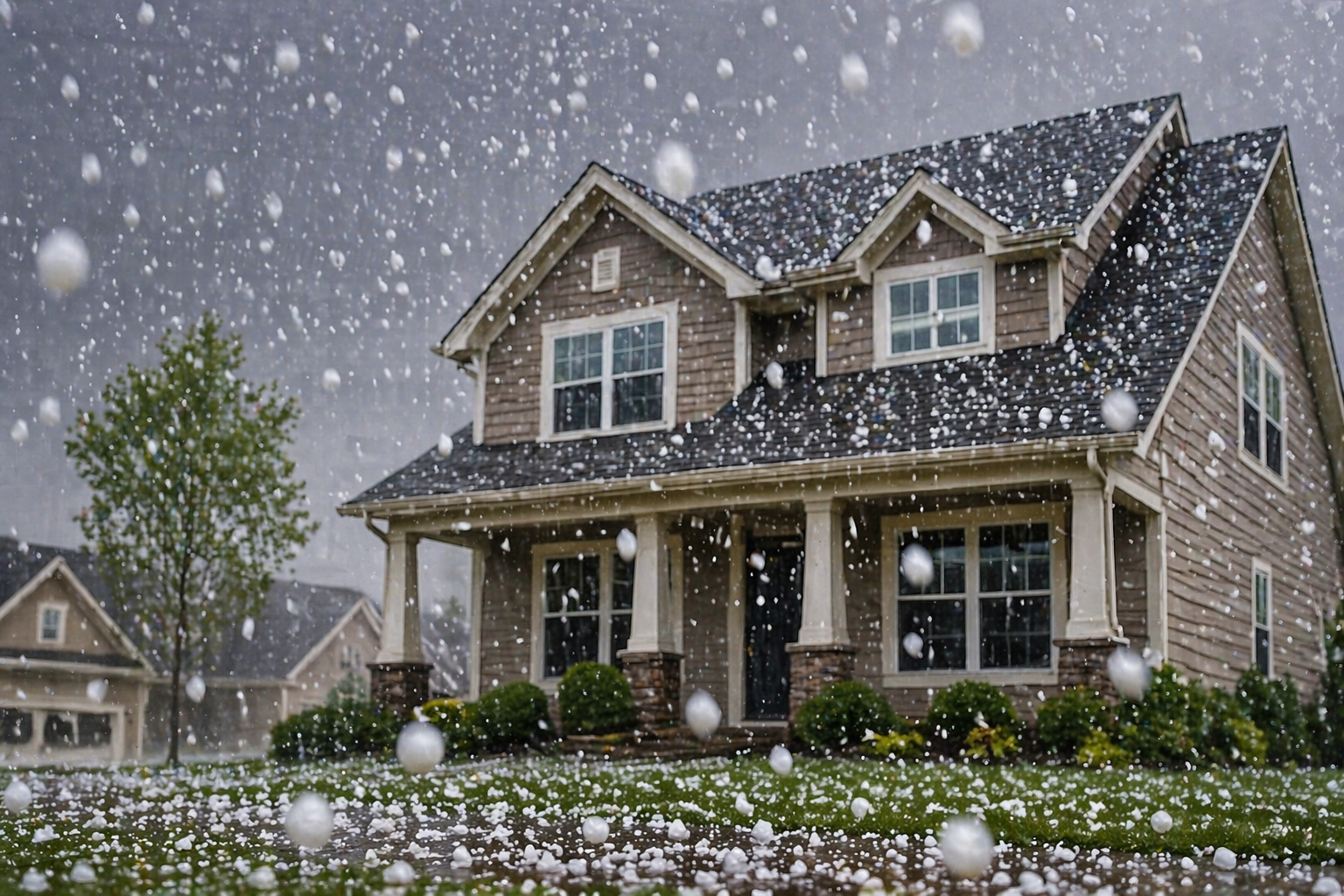
Before You File a Roof Claim, Call a Roofer First
Before filing a roof claim in Wichita, KS, make one call first. Learn how to avoid $0 payout claims and why your deductible matters more than you think.
Living in Kansas, we are no strangers to storms. Storm season is here again, and many parts of the Wichita metro had small hail last night. It does not take much for that familiar thought to creep in as you look up at your roof and wonder if it took a hit. For a lot of people, the next instinct is to call the insurance company and file a claim. Before you do that, there is one step that can save you time, frustration, and potentially money. Call a reputable roofer first.
While it may sound like the wrath of the Almighty, not every storm leaves behind damage that rises to the level of an insurance claim. A good roofer can take a look and tell you whether there is actual damage, how significant it is, and whether it even makes sense to involve your insurance company. That kind of insight is incredibly helpful before anything gets filed.
It is also worth mentioning that you do not need to make a decision overnight. Despite what it may feel like after a storm rolls through, you are not on a 24-hour countdown! Most policies allow anywhere from one to two years from the date of loss to file a claim. You have time to gather information, ask questions, and make a thoughtful decision instead of reacting in the moment.
One of the biggest surprises for homeowners is what happens when a claim is filed but nothing is paid. Once a claim is submitted, it is recorded, even if the outcome is a zero dollar payout. If the adjuster determines the damage is minimal, not covered, or simply does not exceed your deductible, you may end up with no payment but still have a claim on your record. That can impact how you are viewed by insurance companies later on and yes, it has the potential to increase the rate.
Your deductible plays a big role in all of this. If your deductible is $2,500 and the damage comes in at $2,000, there is no payment. At that point, you have gone through the process, filed a claim, and received no benefit. It is not the outcome most people are hoping for when they start the process.
This is where a trusted roofer can be incredibly valuable. A good roofer is not just looking to sell you a roof. They should be willing to inspect, document what they see, and give you an honest opinion about whether filing a claim makes sense. In many cases, they can give you a rough idea of the scope of damage so you can compare it to your deductible and decide how to move forward. The order of operations matters. A storm comes through, you have your roof inspected, you understand what you are dealing with, and then you decide whether filing a claim is the right move. Taking that extra step can help you avoid unnecessary claims and protect your claims history.
Insurance is there for meaningful loss, not every bump or bruise a roof picks up along the way. Having the right people guide you before you file a claim can make the process smoother and help you avoid surprises.
If you are not sure what your deductible is or how a claim might play out, it is worth a quick conversation before anything is submitted.

Is your pandemic purchase protected?
Many of us dealt with our Pandemic blues and boredom by making big changes to our homes. Did you?
During the pandemic, we found ourselves spending a lot more time at home. If you were anything like me, while you were there you made a change or two. You learned how to Zoom. You managed to juggle kids video classes along with your own ever mounting conference calls. You apologized for the dog going bananas in the background while the Amazon driver pulled up to deliver your latest order. And maybe, just maybe, you poured yourself that adult beverage prior to 5 o’clock.
Those weren’t the only changes though. In all this newfound time in our homes, we found that we were missing something. Our abodes in many cases left us wanting. In short, they were too humble for our pandemic tastes. For some of us, that was an additional computer monitor, a new desk, or repurposing a guest room into a home office. For others, perhaps it was new planters to brush up our new passion for gardening. Maybe it was bigger…a bathroom remodel, new pool, or even a sport court. We countered our daily sameness with purchases big and small. According to Statista.com, office furniture sales soared. Desk purchases in the US increased 62.8% in 2020! The Wall Street Journal wrote, “Sales of new residential inground pools grew 24% overall in 2020, a historic increase, according to the Pool & Hot Tub Alliance (PHTA), the largest international trade association for the swimming pool, spa and hot tub industry.”

COVID PURCHASE
Did you add on to you home during the pandemic?
Where you among those that made changes? Did you add onto the house? Finally get that fence put up? Get the pool? Build on? Did you tell your insurance agent when you did it? As spring comes, storm season comes with it and that means homeowner’s claims. Are you up to date? Are you confident that if your home was destroyed by a storm, the policy would cover the house, its exterior features, contents, and all the new improvements you have made? If not, it isn’t too late. Schedule the appointment to sit down and review that coverage. You just may be glad you did.

10 Ways to Save Money on your Car Insurance
Check out our Top 10 Ways to Save on your Car Insurance!
Every day, we work hard to educate our customers to make certain they can make an informed decision on their insurance protections. As insurance professionals, our main concern is with your coverage. Let’s be real though, most consumers are plainly most concerned with pricing. Sure, you want to know that you are covered in the event of an accident. Sure, as a smart consumer, you know that you get what you pay for. That being said, you still don’t want to spend an arm and a leg for insurance. We get it. You’d rather spend those hard earned dollars on something a little more fun. The insurance dollars are necessary though to avoid loosing your shirt in times of crisis. So, what is the answer? How can you save? Here are some of our top tips from the pros at Shepherd Insurance Group.
DON’T skimp on liability. This is what protects your assets and wages from lawsuits in the event that you get in a car wreck that is your fault. A lawsuit can make a bad day turn into a bad (financial) life. DO, however, consider a higher deductible. The deductible is the amount you pay out of pocket before the insurance carrier jumps in to pay for the damages to your vehicle. The higher your deductible is, the lower your premiums will be. $100 out of pocket sounds nice if your car is caught in a hail storm. However, if it costs $300 more per year than a $500 deductible, you need only make it through 1.5 years without an incident for the $500 to be a much better deal.
DON’T wait until the last minute to buy insurance. Oddly enough, insurers know that statistically, those that plan and shop ahead of their expiration date are less likely to get into accidents than those that are buying last minute. Yes, really, there is statistical data to prove this. Therefore, they give better rates to those that shop two weeks before the date of their insurance company change.
DON’T file piddly claims if you can avoid it. If you back into your mailbox and ding up the bumper, you have a $1000 deductible, DO get an estimate before calling your insurer. This was your fault. If it happens to be repairable and is under that deductible amount, there is no need to tell your insurance company about it. Insurance companies believe past claims are an indicator of future claims so why turn it in at all? (Disclaimer…if you damaged someone else’s property or injured someone, you should call your agent.)
DON’T pay late! Did you know that most insurers give customers a “consumer score”? This means they rank you based on a number of factors including credit and if you pay on time.
DO consider telematics. Most carriers now offer some version of an app that monitors how you drive. If you think you are a great driver, this is your opportunity to prove it to the insurer. Pay less than the other people out there that drive like a bat out of Hell pushing up everyone else’s rates. It gives you some control over your rate, in many cases 10-40% off of some coverages!
If you get a speeding ticket, DO consider a diversion to protect your motor vehicle report. The county will sometimes offer a slightly higher fine to keep that ticket off your record. However, the catch is that if you get a second ticket in a (usually) 6 month period, it negates the diversion, so be good!
DO consider defensive driving courses. Many carriers offer a discount for this. Youthful drivers can often take driver’s ed to obtain this discount. For adults, there are many classes online that can be taken or in person.
If you have a student driver, DO encourage good grades. A B average or better almost always results in a nice “Good Student” discount, so turn in those grades to your agent every semester.
DON’T buy that new car. Older models are almost always less expensive than the newer ones. In fact, if your car is old enough, you may want to consider whether or not it merits having “full coverage.” Carrying comprehensive and collision on a car that no longer has much value isn’t always a good idea.
Our top tip? DO consider an insurance broker, like Shepherd Insurance Group, over a captive agent. A captive agent usually offers only one (or very few) insurance carrier(s). If you fit in that carrier’s model, you may get a decent rate. Brokers, conversely, “shop out” your insurance with many different carriers and select the one that offers the best pricing and best coverage FOR YOU! Additionally, if your rate rises in a few years, the broker can simply re-shop it, allowing you to stay with the company in which you already have a relationship. And yes, we realize this is a shameless plug, but it really will save you both time and money!
Are state minimum auto liability limits enough?
Two summers ago, I was driving into town from our rural, country home. It was a bright, perfect, sunny summer morning and I can still remember that I was listening to a story on NPR about a new hot jazz artist that had won acclaim at the Grammy’s when I attempted to skid to a halt. Unfortunately, I had reacted too late. My only excuse is that I was driving into the sun, but I completely blew threw a red light. I was driving a Ford Explorer and plowed into the rear end driver side of an early model PT Cruiser. A young woman hopped out of the car to survey the damage. I must have asked her half a dozen times if she was ok; I was horrified by my reckless driving behavior. She swore up and down she was fine and after the police left the scene, so did she with my insurance information in hand. That was Sunday. Less than 24 hours later the phone rang at my office. The voice on the other end of the phone identified himself as counsel at a local personal injury firm. The young woman I hit hard lawyered up.
The truth is I realize that many people think they are fine in the moment and wake up horrendously sore the day after an accident. I also know there are a lot of people out there looking for something for nothing. But in truth, the result is the same. I didn’t mean to hit her, but she is going to get compensated due to my negligence.
Here is what happens: No one disputes it was my fault. My liability insurance is 250/500/100. What that means is that there is $250,000 for one person’s medical expenses, rehabilitation, funeral costs, and other covered costs if you or your family are at fault in an auto accident. It also pays for settlement of lawsuits and legal expenses. ($500,000 maximum for all the people in her car, so this didn’t apply) and $100,000 for property damage. In this case, the damaged property was the PT Cruiser. I also held a $1,000,000 personal umbrella policy which kicks in for damages over and above the 250/500/100. In other words, she would have to have $1,250,000 worth of injuries before she could go after me and my assets personally.
Now let’s imagine for just a second that instead of 250/500/100, I held the required minimum limit in Kansas. It is a shockingly low 25/50/25. If she has more than $25,000 in injuries or $25,000 in property damages ( a Mercedes instead of a PT Cruiser for example), I would be on the hook for anything above that. In Kansas, assets can be seized to settle the debt or failing that, wages can be garnished. No one wants to lose their savings or income due to a car wreck!
The Ford F-Series is now that most commonly driven vehicle in America. The 2022 Ford F-150 (model with the least features) has an MSRP of $31520. In other words, with state minimum limits, you can’t get into an accident with the most common car on the road today without having to come out of pocket if it is totaled.
You may reason that you are a great driver and you may well be a better driver than me. I can concede this point. However, every time we get out on the road, we see drivers texting. More and more, the guy in front of you is not paying attention. If he unexpectedly slams on the brakes, with all the defensive driving skill in the world, are you sure you’ll stop in time?
There is good news though. Price per thousand, liability is the least expensive coverage you are likely to buy. You can easily set yourself up with the right limits. Most Auto insurance policies offer up to 500/500/500. In our opinion at Shepherd Insurance Group, we err on the side of making sure you have enough liability to make the insurance company more attractive than you in the event of a lawsuit. If you have $1,000,000 in assets, let’s make sure we get that umbrella. If you have $2,000,000 in assets. Let’s make that umbrella a $2M umbrella. What if you don’t think you think you have anything to lose? Think again. Your income can be garnished. Take your household revenue and multiply it by the number of working years you have left.
My final advice? Call your agent and ask what limits you have if you are unsure. Ask what limits they would recommend and get a quote (or better still, call us and ask for a quote!). Lastly, pay attention while you are driving. Accidents happen after all.
Do I need a home warranty?

Remember those old home warranties that the seller threw in to sweeten the deal when you bought your first house? The idea is great. If an appliance peters out in that first year, it is covered. However, if you have ever had your AC die on a 100-degree summer day, you probably realized that warranty wasn’t all it was cracked up to be.
Most warranty companies require that you utilize their network of professional contractors. This means that you must wait until that contractor is available to come out to diagnose the problem. Then you must wait for that contractor to receive the parts. Then you must wait on that contractor to get you on the schedule to come back for install. Meanwhile, you’re sweating to death.
To avoid this frustration, we would offer one of two solutions for you to consider. First, on your homeowner’s policy, you could ask for the Equipment Breakdown Endorsement (or something similarly named). This add-on to your basic homeowner’s policy generally covers permanently installed systems such as air conditioners, furnaces, water softeners, hot water heaters, etc. if they mechanically breakdown after you have met a $500 or $1000 deductible. It is usually pretty darn inexpensive and if it ends up working out for you, it is a winner. However, there are a few small draw backs to consider:
They generally don’t cover appliances but rather permanent systems that require a little demolition to get them out. It isn’t going to cover your state-of-the-art Viking fridge that can be unplugged from the wall.
Most of the time corrosion is excluded. In other words, if it rusts, forget it.
If the item is old, the coverage is likely to be reduced. For example, your AC unit is 16 years old. If it broke down at 14 years, it would have been covered up to $50K. Now at 16 years old, the max coverage is $2500 after a $500 deductible.
When you file a claim, will it be considered a claim on your homeowner’s policy?
The second option is to purchase a home warranty which is a bit more comprehensive. We offer one through Tend which is updated to avoid some of the old pitfalls. The cost is $31.99 with a $500 deductible or $38.99 with $250 deductible. It covers your appliances plus you plumbing, electrical, HVAC, etc. It covers a lot. The biggest benefit, in my humble opinion though, is that it is a reimbursement product. In other words, you choose your licensed contractor, pay them, and Tend will reimburse you within days before the credit card bill arrives. This feature avoids the old “wait for their approved contractor” misery. However, there is a little fine print to note here too:
If the item is old, the coverage is limited here as well.
If your chosen contractor charges a “service call,” you will also be responsible for it.
There is a 30 day wait before your policy can kick in.
If it isn’t obvious, for my money, I tend to prefer the Tend product. (See what I did there! Ha ha!) It just covers more and when it comes to a broken washing machine, dishwasher, fridge, furnace or yes, air conditioning unit—no one likes surprises! Here is the link if you’d like to learn more https://partner.mytend.com/shepherd or of course you can always call at 316-869-1235. We are happy to help provide details and answer your questions. Until then, stay cool out there!
Why do you need renter’s insurance?

The scariest day of my life happened on the coldest night of the year in Chicago in December 2001. I lived near the lake in a tiny studio apartment. I had just gotten into bed when someone began to pound on my door. “Get out! Get out! The building is on fire!” Since I didn’t really know anyone yet in the windy city, I was annoyed as I rose from my bed to see who this prankster was. Ready to give the knocker a piece of my mind, I eased the door back a crack to see who it was. Smoke immediately enveloped me.
I slammed the door, threw on the jeans, sweater, and boots that I had just removed, and grabbed my heavy woolen coat. Thankfully, my keys and cellphone were in my pocket as I raced down 4 flights of stairs. As I reached the fifth floor, another unknown neighbor grabbed me by the arm and shouted, “Not that way!” Immediately, I fought down the panicked thoughts that I was going to die in a building fire tonight and tried to clear my head. We unlocked arms and ran for the exterior fire escape. We eased out onto the icy iron steps and began to descend as quickly as we could. Though it was on the next side of the building, I could see flames shoot out of the windows and I could hear the glass shattering. When we reached the bottom of the fire escape, we had to jump for the bottom. As my boots hit the concrete, I slipped and fell on a patch of black ice. Mercifully, I managed to get my hands under me, shielding my backside from the impact.
We soon discovered that we were like cattle in a holding pen. The air conditioning units were protected by a 10-foot fence with barbed wired at the top and the gate was padlocked shut making our exit impossible. The neighbors from the high-rise next to us located a ladder and began to cut the dangerous wires away. We began boosting screaming, panicky bodies over the fence until someone (presumably a sleepy super) finally showed up with the padlock keys.
Shivering and miserable, we were herded into the lobby of an adjacent building. When the cold started to wear off, I finally realized that my hands were covered in blood from where I had caught myself. I had a smear or two on my face and looked an absolute fright which met how I felt. Now that I was out of danger, what was I going to do? Where was I going to go? Would the fire department put of the flames before it reached my floor?
So, let me answer the question posed in the title: Why do you need renter’s insurance? You need it for nights like these. If my possessions were destroyed, I lacked any funds to replace them. If I had been the one that caused the fire (a man on the fourth floor left a candle burning and the flame had sparked catching his curtains on fire), it would protect me from the impending lawsuit from both the tenants and the building owner. I had nowhere to stay that night. Renter’s insurance not only covers the dollars to replace possessions and liability, but also covers hotel bills if one is displaced from their home. I was so scared, that I didn’t even have the presence of mind to grab a wallet. I had zero dollars (and even if I had grabbed my purse, I was a broke 23-year-old kid who had just moved to the big city and didn’t have any friends to crash with yet).
The good news is that even though I was out in in subzero weather for several hours, I did get back into my apartment that night mercifully. Sure, it smelled like a bad barbecue gone awry for weeks, but my apartment was intact. Anyone who lived on the fourth floor and under was not so lucky. The fire hadn’t destroyed the building, but the smoke and water damage was substantial. As one of the lucky ones, I felt so bad for those unknown neighbors who were not as fortunate. They were displaced for weeks.
The point of my cautionary tale is this: you may be the most responsible person in the world, but your neighbors are not, and accidents happen. Get renter’s insurance. It is usually less than the price of a pizza per month and provides protection that is worth every cent.

Building a Business? Better get the right insurance to protect it!
When starting a business, how you protect it is equally as important as how you plan to grow it.
As an entrepreneur, let’s face it, there are just about a million and one things on your to-do list. How will you get customers? How will you keep customers? How will you distribute your product? Hire, manage, and track employees? Inventory? And the list goes on and on and on…
One of the less sexy decisions you face is how to protect that asset you are building and who will help advise you on something that may not exactly be in your wheelhouse? Let’s start with the “Who”. When choosing an insurance advisor, start with the most basic questions.
Do I want face to face meetings with someone?
If so, make sure you select someone local.
Is the person who sold you the product who you will work with or does he/she have a service team?
Do I want a brokerage or a captive agent? What is the difference?
Captive agents offer generally one carrier only. If you seek out the help of a captive, that agent will prepare a quote for you only with the carrier she/he offers. If you fit that mold, the quote coverage and pricing may be great. If you don’t fit, you may be very limited in coverage options and pay more to get it. The benefit here is that it is likely the agent will know the product well. They only offer one.
A brokerage offers many carriers. For example, at Shepherd Insurance Group, we offer dozens of companies to shop out our customers information to achieve the best pricing and coverage for our client’s individual needs. The benefit here is that it often saves time and money because you needn’t call 5 different agents to get 5 different proposals. You give your info once. You listen to one proposal. If the market shifts and prices rise, you needn’t go get a different agent. Ask your existing one to re-shop for you.
Who will handle my claim if something happens?
Do I have local help if I want it?
Does the carrier have adjusters near me?
What is the experience of my agent? Are they new to the industry? (Claims is not usually where you want a newbie.)
Once you have selected who you will get proposals from, let’s establish what types of coverage you need as a business owner. While some items will be unique to your profession, here are some bases to make certain you cover.
Liability
General Liability covers bodily injury and property damage that you or your crew, your product, or service may cause. This one is a must for pretty much everyone!
Auto Liability covers when you or your employees are in a car and you injure someone or damage property. This is one of your largest exposures. Do not skimp here. (Also, you may need to consider Employers Non-Owned Liability if your employees drive their own vehicles in the course of business. Great examples are if your admin makes a trip to the bank on her way home or your line cook runs to the market to pick up extra veggies in his own car.)
Professional Liability Insurance is for mistakes you make working in the course of your profession. For example, as a stylist, the product you mix for coloring a clients hair gives them a reaction and she sues or perhaps as an accountant you missed a filing for one of your clients. To err is human, to be protected is just good common sense!
Employment Practices Liability protects you against suits that may arise as a result of dealing with employees. Wrongful termination, harassment, or discriminatory issues fall under this coverage. This one is often overlooked and unfortunately, suits are very common. The profession doesn’t matter.
Property
Business Personal Property is everything the moving truck would bring to your location. Inventory, stock, furniture, computers, equipment, etc. (Pro tip: if you are a business that has more inventory depending on the season, ask about seasonal coverage.)
Do you own your building? This is an obvious asset that will need insurance and if you carry a loan the lender will require it.
As a tenant, you may not be required to carry this, but I think you’d be crazy to skip it. Did you make any improvements to the space? If you are a boutique, did you add fitting rooms? Or maybe in the office you rented you put up a wall with a window to create a reception area. Landlords are not required to repair these improvements if there is a loss. Be sure to read your lease carefully. Even though the landlord’s policy should cover the building, they often slide in requirements that you are responsible for windows or the air conditioning unit. Make sure your agent knows about those requirements.
Workers Compensation
State law varies here, but a good rule of thumb is that if you have employees you should have workers comp.
You will be liable to pay for injuries incurred on the job, so it is a great idea to protect yourself from the get-go.
Life Insurance and Disability Planning
Key Person insurance covers employees that are indispensable. If you lost your best sales person, what would happen to the business? How long would it take to replace that person? Would you need signing bonus money? Money to hire and attract talent?
Buy Sell Insurance Plans provide for partnerships to be dissolved. If something happens to one partner, the other doesn’t automatically receive the other half of the business. The next of kin inherits. Do you really want to share the business with your partner’s second wife? Buy Sell Insurance allows you to have the funds to buy out the family without disinheriting them.
Legacy planning and protecting your family can also be covered by having a simple discussion with your life insurance professional.
While the list above is certainly not all encompassing, it should at least give you a place to start...so get started! If this isn’t an area that you know a lot about, ask a few other business owners you trust for a referral and start asking questions. Great advisors will take the time to answer your questions and tailor coverage and policies to you. If not, well, we already established that you have a million and one things to do. Move on to an advisor who will take the time and get yourself covered!

Dealing with Destruction in Andover, KS
The EF3 tornado that struck Andover the evening of April 29, 2022 decimated homes, snapped great oaks in half, and ripped apart community buildings and schools.
As my family and I sat down to dinner in a local pizza place, a cacophony of phones began to blare warnings which was only eclipsed by the screaming sirens outside. The patrons of the busy restaurant crowded into the windowless bathrooms for protection. Small children were oblivious or terrified depending on their mother’s poker face as she wondered if the impending tornado would strike her home. Unfortunately, many of those mothers’ concerns were well-founded.
The EF3 tornado that struck Andover the evening of April 29, 2022 decimated homes, snapped great oaks in half, and ripped apart community buildings and schools. All in all, city official’s early estimates say that up to 100 structures received significant damage, not to mention to widespread pea to golf ball-sized hail that pounded the surrounding metropolis. Miraculously, no deaths were reported!

Picture taken near the Sedgwick and Butler County, Kansas line.
The devastation is shocking. Tornadoes are mystifying in their senseless path of chaos. It misses one neighbor entirely only to level the next cul-de-sac. The official Andover City page pleads with Good Samaritans to stay home and let first responders deal with the dangerous gas leaks and felled power lines. As our community sifts through the rubble, we find there are as many questions as answers. Where can we help? What can be done?

Andover, KS Tornado destruction April 29, 2022
For our part, as an independent insurance brokerage, we hope to be a resource for our clients and fellow neighbors during this difficult period. Here are a few common questions we have received during this catastrophe:
What if it isn’t safe to stay in my home?
For homes that are uninhabitable due to storm damage, most homeowners’ policies will provide for hotel stays. Be sure to hold onto receipts not only for the night’s stay but also for meals, toiletries, and prescriptions that had to be filled due to the displacement.
Do I need to file my claim today?
The short answer is no. Concentrate on staying safe and mitigating further damage. The claim can be filed later. Most carriers offer 1-2 years from the date of loss to complete repairs.
Should I file a claim to have my home checked for hail damage?
We would recommend that you start with an independent roofer first. A roofer (or two) can evaluate if you sustained damage. Once they have verified damage, call your agent to file the claim. We recommend this for one simple reason: if there is no damage and a claim is filed, it can result in a $0 payout claim which can raise your rates. It is important to try to only file claims that exceed your deductible amount.
Should I trust a roofer or contractor that stops by my home and offers to give a bid?
Buyer beware. Is this a local company? How long have they been in business? What is their rating on the Better Business Bureau? Do they have reviews online? Sometimes a referral from your local agent or neighbor goes a long way toward avoiding fly by night storm chasing “roofers” that disappear with your down payment.
My car has hail dents. What do I do?
Verify that you have comprehensive (or Other than Collision) coverage and inquire about your deductible with your agent. Assuming the damage exceeds your deductible, file the claim with your agent.
My business is damaged. I don’t think I can be open for business tomorrow!
Most business owner’s policies provide coverage for lost revenues due to closures that happen due to storm damage. Call your agent to see what is provided.
For my part, as I filed out of the restroom with the rest of the relieved customers at the pizza place, I was grateful. Grateful the building was still standing unharmed. Grateful for the cell phone in my hand that allowed me to immediately know that my other loved ones were safe. Grateful to know that my own house was still standing. My heart aches for those that weren’t as fortunate as I, and I will admit to a sour feeling of helplessness. I hope that this information will help at least one person. Call us if you need us. For those that are hurting, we will be here filing claims, answering questions, and praying for you.